


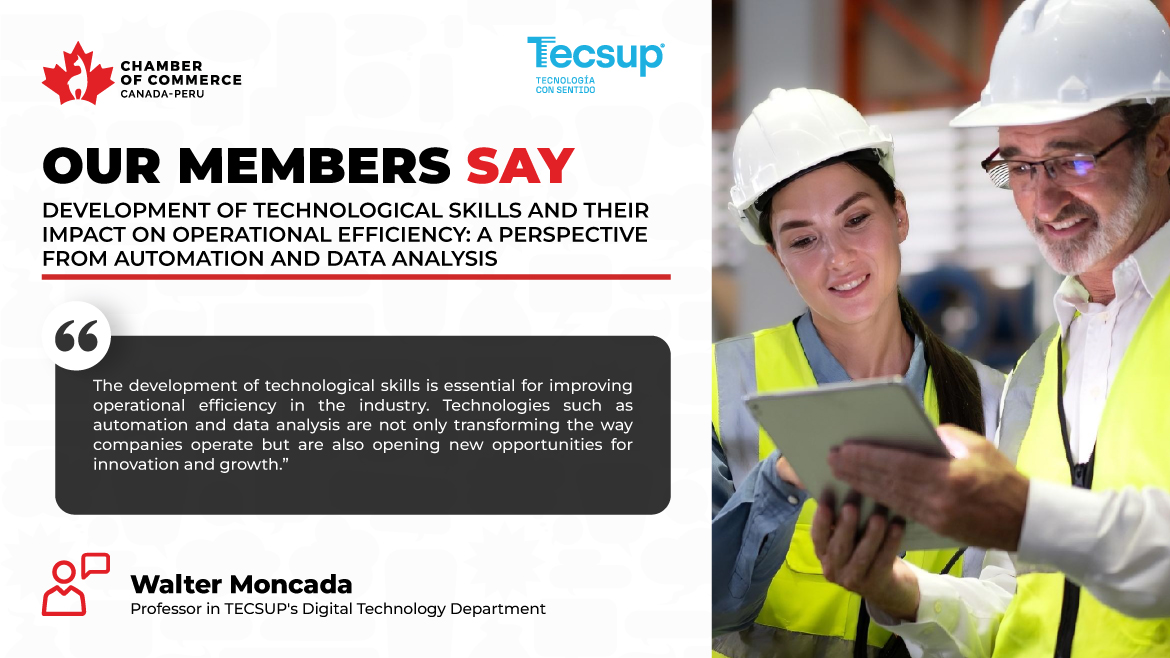
Development of Technological Skills and Their Impact on Operational Efficiency: A Perspective from Automation and Data Analysis
In today's industrial environment, characterized by fierce competition and the constant need for optimization, the development of technological skills has become an essential pillar for improving operational efficiency. The integration of advanced technologies, such as automation and data analysis, is not only redefining how industrial processes are carried out but also driving organizations to reach new levels of productivity and precision.
Digital Transformation and Its Impact on Operational Efficiency
Digital transformation in the industry has brought with it a series of innovations that have radically changed the operational landscape. Skills in technologies such as automation, data analysis, and artificial intelligence (AI) have proven to be essential for achieving efficiency in industrial processes. Automation, for example, has enabled companies to reduce human errors, speed up production times, and minimize operational costs. On the other hand, data analysis provides valuable insights that allow organizations to make informed decisions and continuously improve their processes.
Automation: Redefining Industrial Processes
Automation has become the main driver of operational efficiency in many industrial sectors. From automated assembly lines to AI-based quality control systems, automation is eliminating repetitive and error-prone tasks, allowing human resources to focus on higher-value-added activities. The implementation of technologies such as SCADA (Supervisory Control and Data Acquisition) systems and PLCs (Programmable Logic Controllers) has enabled companies to monitor and control complex processes in real time, reducing downtime and optimizing resource use.
Organizations that have embraced automation have not only seen improvements in product quality but also experienced increased energy efficiency and reduced maintenance costs. These improvements are made possible by automation's ability to make precise adjustments to processes based on real-time data, minimizing waste and maximizing production.
Data Analysis: Informed Decision-Making
Data analysis has revolutionized the way industries operate. With the massive amount of data generated by automation systems and other industrial processes, data analysis has become a crucial tool for improving operational efficiency. Through techniques such as data mining, machine learning, and predictive analytics, organizations can identify patterns, predict failures, and optimize their operations.
A clear example of this is predictive maintenance, which uses data analysis to predict when equipment is likely to fail, allowing companies to perform preventive maintenance before costly breakdowns occur. This not only reduces downtime but also extends the lifespan of equipment, resulting in significant long-term savings.
Tecsup: Specialized Training for the Industry of the Future
In this context of digital transformation, the need for highly skilled professionals in advanced technologies is more evident than ever. Tecsup, as a leader in technical and technological training, positions itself as a strategic ally for companies seeking to remain competitive in an increasingly complex and technological industrial environment.
Tecsup offers a wide range of specialized training programs in key areas such as industrial automation, data analysis, industrial cybersecurity, and applied artificial intelligence. These programs are designed not only to provide solid technical knowledge but also to develop the practical skills necessary to implement these technologies in real industrial settings.
Programs in Industrial Automation
Tecsup's industrial automation programs are aimed at training professionals capable of designing, implementing, and maintaining complex automated systems. With a focus on practical experience, students learn to work with cutting-edge technologies, including PLCs, SCADA, and Distributed Control Systems (DCS). Additionally, Tecsup works closely with the industry to ensure that its programs are aligned with current market needs, guaranteeing that graduates are prepared to face the challenges of the sector.
Training in Data Analysis and Digital Transformation
Tecsup's data analysis training is designed to equip professionals with the skills to interpret and use data for strategic decision-making. Through programs that combine theory and practice, students learn to use data analysis tools such as Python, R, and specialized software to extract valuable insights and apply them to optimize industrial processes.
Furthermore, Tecsup offers continuous training programs in digital transformation aimed at professionals seeking to update and acquire new competencies in emerging technologies. These programs cover topics such as process digitization, systems integration, and technology project management, enabling participants to successfully lead digital transformation initiatives within their organizations.
Conclusion
The development of technological skills is essential for improving operational efficiency in the industry. Technologies such as automation and data analysis are not only transforming the way companies operate but are also opening new opportunities for innovation and growth. In this context, the specialized training offered by Tecsup becomes an indispensable resource for organizations seeking to remain competitive in an increasingly digitized environment. By training highly skilled professionals in advanced technologies, Tecsup is significantly contributing to the development of the industry of the future.
Author: Walter Moncada, Professor at the Digital Technology Department of Tecsup