




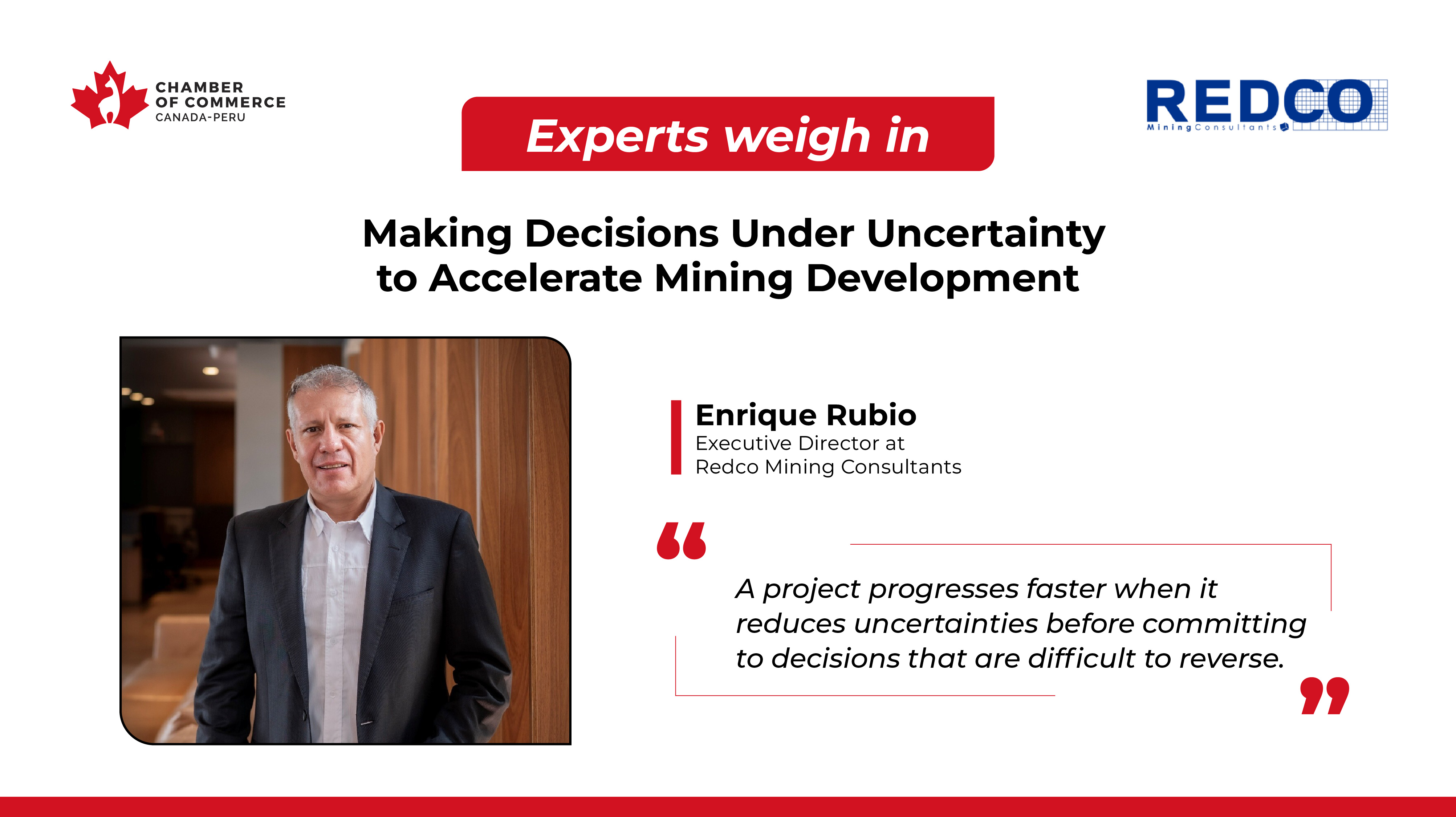
Making Decisions Under Uncertainty to Accelerate Mining Development
Mining faces a paradox. The energy transition, electrification, and the expansion of data centers are increasing pressure on critical minerals, while the projects needed to meet this demand are becoming increasingly complex. In addition to geological uncertainties, regulatory, environmental, social, commercial, and financial variables can change over years of development.
In this context, accelerating a project does not simply mean compressing its schedule. It means structuring decisions to address first the uncertainties that could change the project’s design, scale, or viability. This distinction is important: advancing engineering does not always mean reducing project risk.
A useful approach is based on three principles. The first is modularization: breaking the mining system down into repeatable and standardized components, for example, extraction, ground support, or drilling modules, allows capacities to be adjusted more flexibly and limits exposure associated with highly customized designs.
The second is phased growth. Instead of committing to the full capacity and capital from the outset, a project can advance through staged decisions linked to technical and commercial evidence. Each stage should preserve options: expand, modify, postpone, or stop. This does not eliminate uncertainty, but it prevents assumptions that are still fragile from being treated as certainties.
The third principle is to focus decision-making on risk reduction. Simulation tools, advanced analytics, and artificial intelligence make it possible to compare numerous scenarios and identify which variables have the greatest impact. However, their value lies not in replacing technical judgment, but in directing it toward the questions that truly influence the decision.
Experience in underground copper projects in the United States, phosphate projects in Brazil, and large-scale mining in Chile shows that the main obstacle is not always the orebody. It may lie in enabling infrastructure, permitting, community relations, availability of capabilities, or the sequence of investments. Identifying the bottleneck early changes where studies and capital should be focused.
This logic is particularly relevant to the transition of Chilean operations toward large-scale underground mining. Methods such as Block Caving and Panel Caving require significant investment and involve decisions that are difficult to reverse. Therefore, sustainable speed does not come from deciding everything upfront, but from learning in time, keeping alternatives open, and committing resources when there is sufficient evidence.
Author
Enrique Rubio
Executive Director, REDCO Mining Consultants