




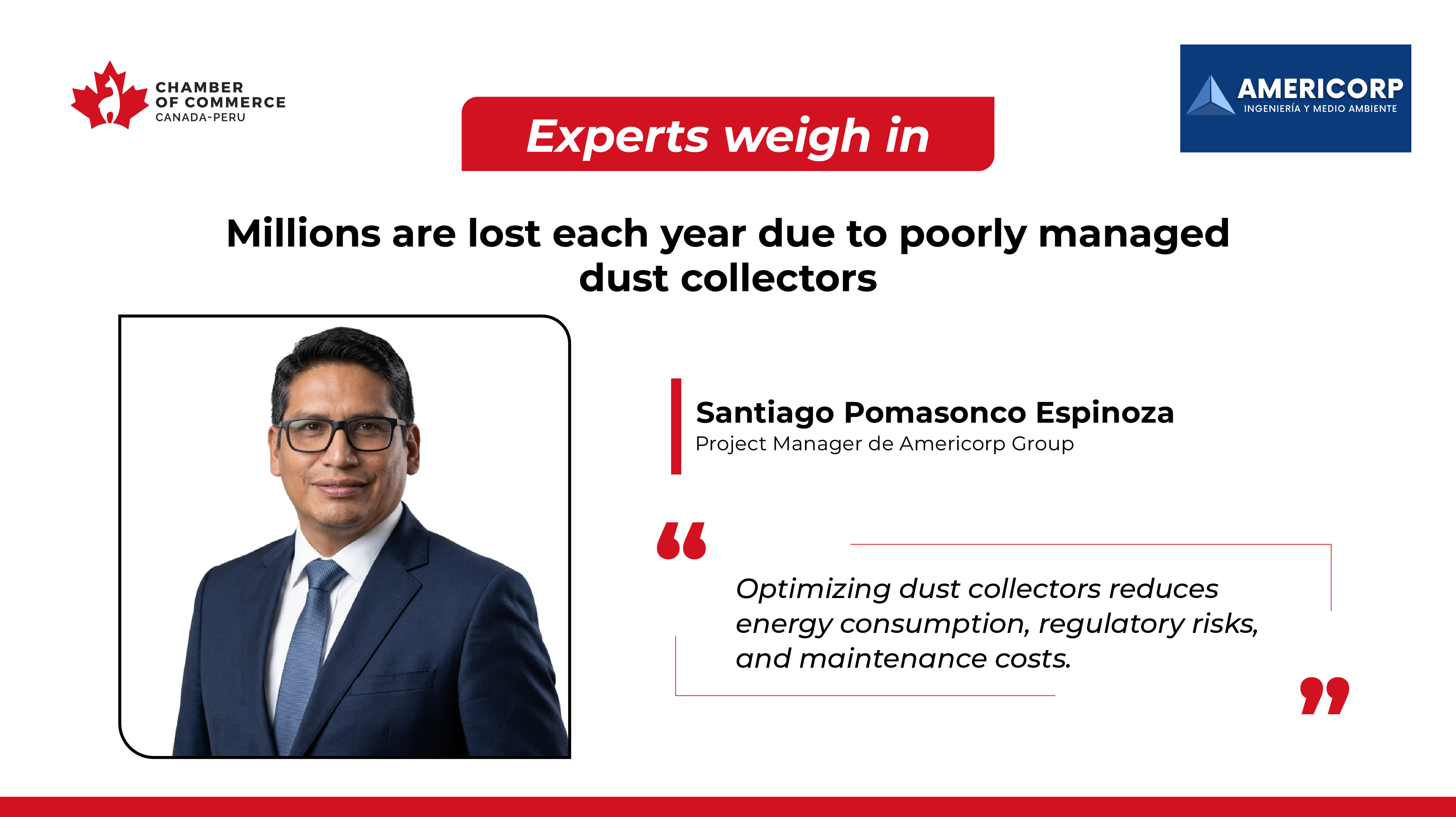
Millions are lost each year due to poorly managed dust collectors.
In the mining industry, dust collectors are often treated as a secondary operating expense, just another line item within the maintenance budget. Technical evidence, however, points in a different direction. A poorly calibrated dust collection system can account for up to 30% of a processing plant’s total energy consumption, and in high-throughput operations, that percentage can translate into hundreds of thousands of dollars in avoidable annual costs.
The core issue is not technological, but managerial. Mining operations frequently oversize their dust collection systems, particularly pulse-jet fabric filter units, under the assumption that greater capacity equates to greater operational security. The result is equipment operating well below its design efficiency, generating unnecessary pressure drops and driving motors that consume energy without optimizing the actual dust capture requirements.
The solution lies in adopting adaptive control strategies. Modern systems equipped with differential pressure sensors and variable frequency drives (VFDs) on fans can adjust airflow in real time according to dust loading conditions. In operations where particulate generation is intermittent, such as primary crushing circuits or conveyor transfer points. This modulation capability can reduce electricity consumption by 20% to 40% compared with fixed-speed systems, without compromising collection efficiency.
There is also a regulatory dimension that further strengthens the economic case. The ongoing tightening of PM2.5 and PM10 emission standards across Latin American regulatory frameworks is increasing the cost of non-compliance, both through direct penalties and the potential suspension of operations. In this context, investing in dust collection efficiency is not merely an energy-saving measure; it is a strategic safeguard against regulatory risk.
Predictive maintenance specialists have already integrated dust collector monitoring into root cause analysis frameworks. When a collector operates outside its optimal differential pressure range, filters deteriorate prematurely, cleaning cycles become inefficient, and the service life of filter bags is significantly reduced. Each of these events carries a direct and measurable financial impact.
The real paradigm shift in this field does not lie in adopting newer equipment, but in operating existing assets with greater process intelligence. Energy efficiency in dust collection systems is not a challenge that requires cutting-edge engineering; to a large extent, it is a matter of operational discipline, technical judgment, and informed decision-making.